Framework I

Revere's Law of Market Magnetism

"Market magnetism follows symbolic resonance, not demographic proximity."

Most brands approach new markets with demographic logic: identify the segment, allocate the media budget, optimize the creative. This model fails in markets where cultural trust is the determining variable β€” and the Black American consumer market is the most culturally trust-dependent market in the United States.

Demographics tell you who is in a market. Symbols determine whether that market will accept you into it. A brand can segment a demographic with precision β€” correctly identifying age range, income level, media consumption habits β€” and still be rejected entirely. Because rejection in this market is not about reach. It's about resonance.
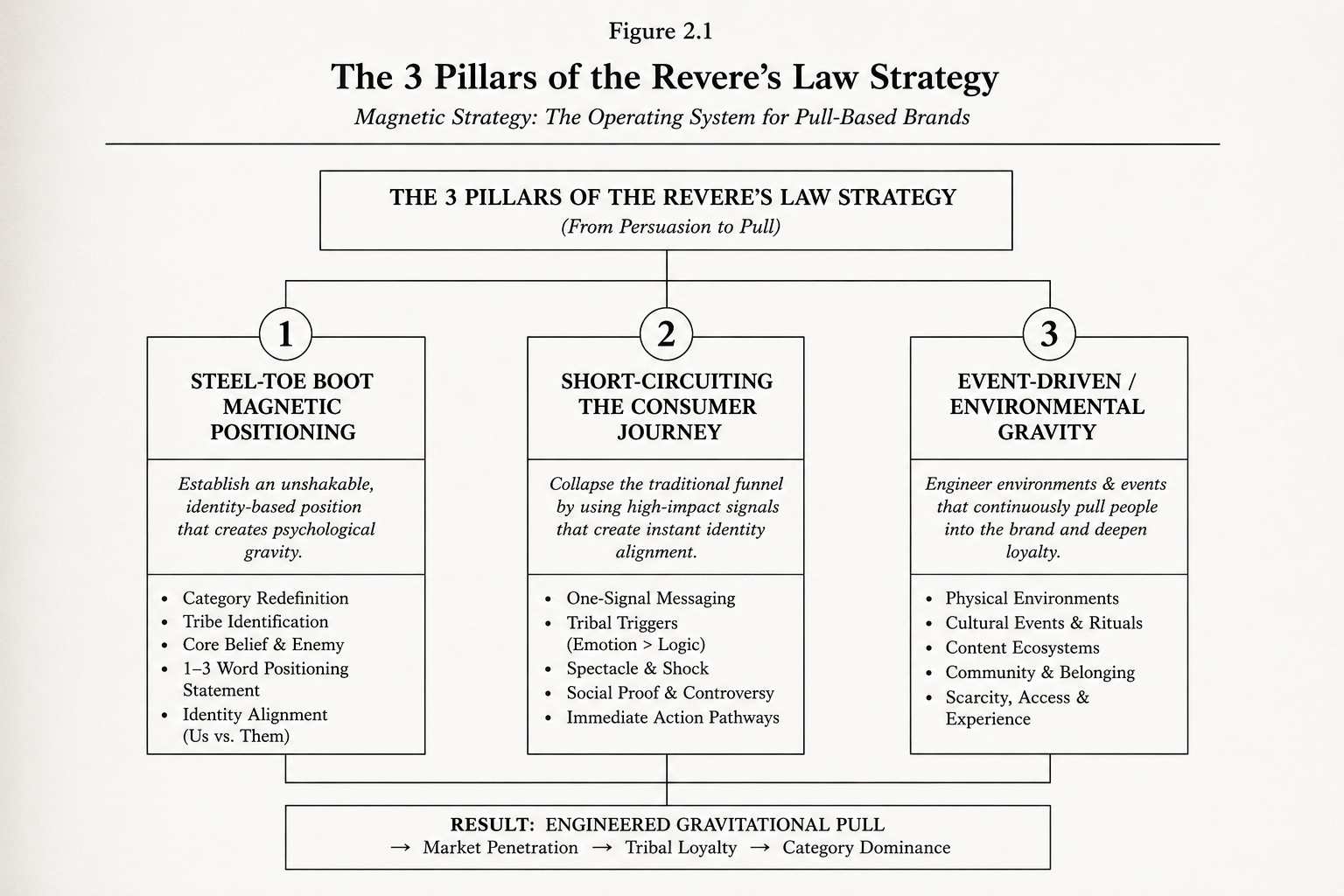
Revere's Law of Market Magnetism β€” Visualizer

The Law, Stated

"Market magnetism follows symbolic resonance, not demographic proximity."

What this means: Your brand does not enter this market through advertising spend. It enters through symbolic alignment β€” or it does not enter at all. Every brand that has succeeded in the Black American consumer market did so because the market decided the brand carried the right symbolic weight. Every brand that has failed did so because it misread β€” or ignored β€” the sign system entirely.

The implication: You cannot buy symbolic resonance. You cannot hire it through an influencer. You can only earn it by understanding what the sign system values and demonstrating authentic alignment. Revere Marketing Moguls exists to translate that understanding into actionable brand strategy.


Watch the Framework Explained

Revere breaks down the law in his own words:

Why Demographic Targeting Fails Here

Demographic targeting assumes that proximity β€” geographic, economic, generational β€” creates market affinity. In most markets, this assumption is serviceable. In the Black American consumer market, it is structurally incorrect.

This market operates on a high-context cultural code. The meaning of a brand is not determined by its product attributes or its price point. It is determined by the symbolic position the brand occupies within a network of cultural references, associations, and values that the market has built and maintains entirely independently of whatever the brand intends to communicate.

Bud Light did not fail because of bad creative. It failed because its activation sent a signal β€” intentionally or not β€” that the market read as symbolic misalignment with its own values. The market responded at $1.4 billion in losses. The brand had no framework for understanding what it had done or why.

Baudrillard's Foundation

Jean Baudrillard's system of objects provides the theoretical backbone. In postmodern consumer culture, objects no longer satisfy needs β€” they signify social position within a code. The Black American consumer market operates at the advanced edge of this system. Brands are not products here. They are signs. And signs are either legible or they are not.

The Sign System You're Entering

Every brand that enters this market immediately becomes a symbol. The market assigns it a meaning. That meaning determines acceptance or rejection β€” often in hours, sometimes virally. The brand does not control what symbol it becomes. The market does. Your job, with our help, is to ensure the symbol it becomes is the one you intended.

Articles on Revere's Law

Essays applying this principle directly to market strategy:

Read all on Substack β†’

Ready to Apply the Framework?

Book a strategy call. We'll diagnose your brand's current symbolic position and map the path to market entry.

Book a Call β€” Starting at $4,500/day